Affective Acting Training
Acting and acting training occasionally appear as fields of paradox. One such paradox is the engagement with affect and emotion.
To invoke the Dojo's signature acting / actor framing, it's curious that engaging with emotion whilst acting is a primary concern (in Western contexts, at least), but engaging with emotion as an actor is rarely considered.
This is especially curious, as we know that performing – across performance domains – is an emotionally laden endeavour.[1] And, surely, of the performance domains, acting would rank toward the top, given that engaging with and communicating through emotion is a far greater percentage of our job than most others.
Curious still, some of these non-acting performance domains have begun to connect the dots: if we know that performing is inherently emotional, why not explicitly train performers to be prepared for this inevitability?[2] Sport (leading the charge as almost always), for instance, has forwarded Affective Learning Design.
In this article, we propose the idea of Affective Acting Training and argue why such an approach may make for more effective acting training.
Backed by science; built for the stage and screen.
👊 Actors:
Get evidence-informed insights and strategies to support your performance and well-being. Join the Dojo e-newsletter tribe and make thriving your reality.
🧭 Drama schools & Production companies:
Bring pioneering, research-backed coaching into your classroom or rehearsal room. Let's talk about supporting your actors to perform at their peak – and stay well in the process.
Affective Learning Design
First, let's get us all on the same page and distinguish between three related but distinct phenomena: affect, mood, and emotion.
- Affect is the broadest of these phenomena. Affect is the experiential field from which mood and affect arise.[3]
- Mood sits between affect and emotion: less intense than emotion but more intense than affect; less sustained than affect but more sustained than emotion.[4]
- Emotion is the most context- and time-bound, elicited in response to a specific stimulus and lasting only seconds or minutes.[5]
For the purposes of this article, we'll be focusing on affect and emotion.
As mentioned in the intro, Affective Learning Design (ALD) has been developed to help practitioners design "emotion-laden" training that better represents the emotion-laden-ness (a word we'll temporarily invent) of performing.[6] As sport researchers have argued, "If we are to understand sporting performances and train for them appropriately, emotions cannot be left out of the equation".[7]
Of all the emotions we may experience whilst performing, anxiety is among the most salient. Indeed, "anxiety is the single most researched emotion in the sport psychology literature".[8]
Consequently, several ALD-aligned frameworks have been developed to address the anxiety that can be elicited when performing under pressure. Pressure Inurement Training (PIT) is one.
Research suggests that PIT can have at least a medium positive effect,[9] for both novices and experts,[10] and is perceived to improve self-confidence and emotion regulation,[11] as well as psychological resilience and adaptive coping,[12] thereby indirectly enhancing performance.
In sum: "Training environments offering implicit learning opportunities and effective utilisation of pressure training can prepare athletes for performing well under pressure".[13]

Affective Acting Training
Inspired by the advancements and innovations of other performance domains, we propose a conceptualisation of Affective Acting Training, drawing on the overarching approach of ALD and the more targeted framework of PIT.
The (proposed) basic principles:
- Integrate PIT into the actor's existing physical and psychological training.[14]
- Introduce pressure gradually and progressively.[15] [16]
- Reflect the pressures of the audition / screen / stage performance context as closely and comprehensively as possible.[17] [18] [19]
- Tailor and adapt the pressure to the individual actor.[20]
- Debrief thoroughly and transparently after each PIT session.[21]
Some (proposed) specific strategies (once the principles outlined above are in place):
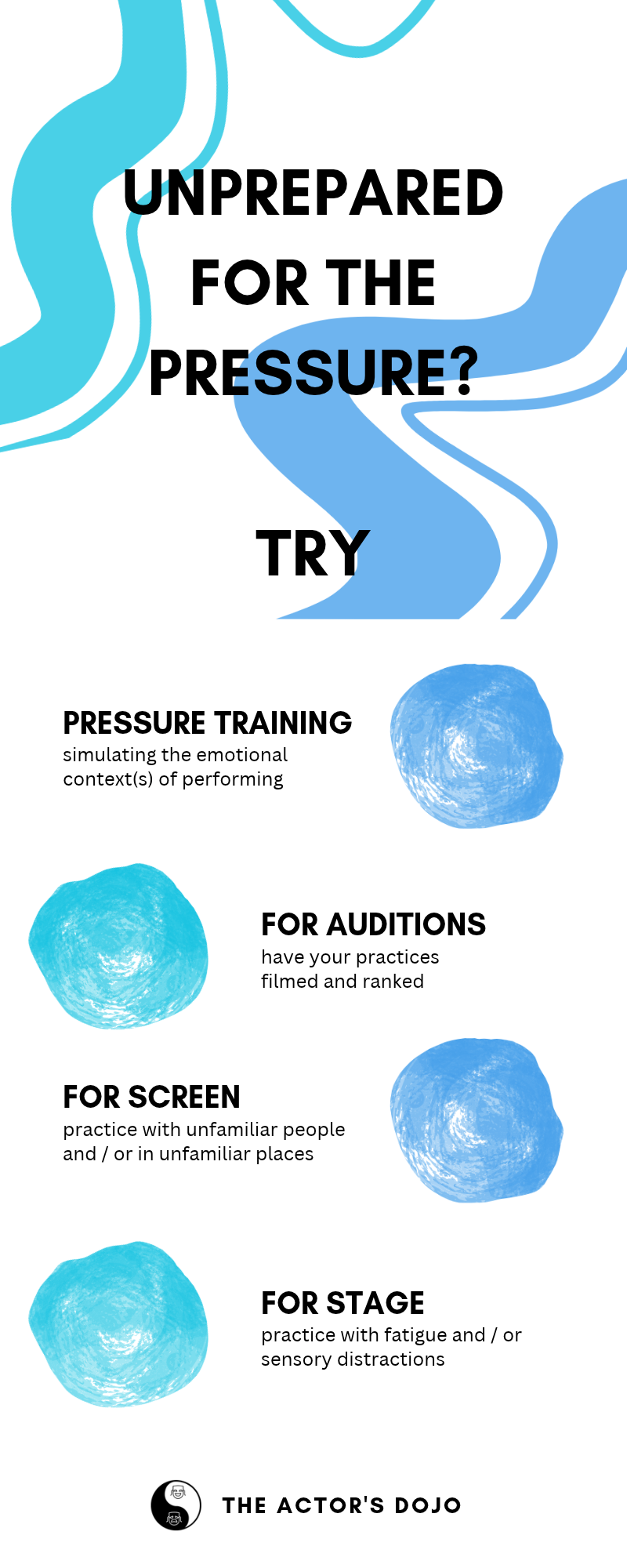
- Simulate the emotional context of auditions by filming practices, limiting feedback after practices, and / or having practices "ranked".[22]
- Simulate the emotional context of screen work by constraining the time given to practice, practising in front of unfamiliar people, and / or practising in unfamiliar environments.[23]
- Simulate the emotional context of stage work by constraining practice to only one attempt, practising pre-fatigue, and / or adding practising with sensory distractions.[24]
- Pair PIT with mindfulness- and acceptance-based practices and psychological skills training.[25]
TL;DR?
No worries. Here are the three key takeaways:
- Performing is an inherently emotionally-laden endeavour.
- Affective Learning Design (ALD) offers an overarching approach to training with emotion, so we're better prepared for performing with emotion.
- Pressure Inurement Training (PIT) provides a targeted framework to train with and for anxiety.
Love what you're reading? Help us keep it flowing. Donations support the research, writing, and free sharing of evidence-informed tools for actor performance and well-being. Every dollar fuels our mission to make thriving a reality for actors everywhere 🔥
Citations
[1] https://psycnet.apa.org/record/2019-19671-002, p. 2
[2] https://psycnet.apa.org/record/2019-19671-002, p. 5
[3] https://doi.org/10.1017/CBO9780511820724, p. 40
[4] [5] https://doi.org/10.1017/CBO9780511820724, p. 47
[6] https://doi.org/10.1016/j.psychsport.2014.08.006, p. 83
[7] https://psycnet.apa.org/record/2019-19671-002, p. 14
[8] https://doi.org/10.3389/fpsyg.2023.1207623, p. 1
[9] [10] https://psycnet.apa.org/doi/10.1037/spy0000202, p. 158
[11] https://doi.org/10.1080/1750984X.2025.2578781, p. 19
[12] https://doi.org/10.1080/1750984X.2025.2578781, p. 21
[13] [25] https://doi.org/10.1007/s40279-026-02472-x, p. 1851
[14] https://doi.org/10.1080/21520704.2016.1255496, p. 148
[15] [20] https://doi.org/10.1080/1750984X.2025.2578781, pp. 28–29
[16] [18] https://doi.org/10.1080/1750984X.2025.2578781, p. 25
[17] https://doi.org/10.1007/s40279-026-02472-x, p. 1854
[19] https://doi.org/10.1016/j.psychsport.2014.08.006, p. 86
[21] https://doi.org/10.1080/1750984X.2025.2578781, p. 26
[22] [23] [24] https://doi.org/10.1080/1750984X.2025.2578781, pp. 15–17
Cite us!
IG: @theactorsdojo
APA 7: Norrish, T. (2026, October 29). Affective acting training. The Actor’s Dojo. LINK