Interpersonal Effectiveness for Actors
It was only relatively recently that we clocked something curious: actors aren't explicitly taught interpersonal skills.
Which, given that we work so intimately with our peers and colleagues on such "characteristically brutal" schedules,[1] seems like a skill set we'd benefit from having.
To give credit where credit's due, this observation wasn't a stroke of genius on our part – it was independently flagged by three of eight student actors we interviewed at the conclusion of a psychological skills training program we ran at their drama school over a semester.[2] Hat tip to these perceptive humans.
And it turns out they may have been onto something. There's a sizeable body of research demonstrating the critical importance of high-quality relationships in performer thriving.[3]
So, in this article, you'll learn about one framework for interpersonal skills training and three evidence-based ways to tactically-practically start strengthening those skills today.
Backed by science; built for the stage and screen.
👊 Actors:
Get evidence-informed insights and strategies to support your performance and well-being. Join the Dojo e-newsletter tribe and make thriving your reality.
🧭 Drama schools & Production companies:
Bring pioneering, research-backed coaching into your classroom or rehearsal room. Let's talk about supporting your actors to perform at their peak – and stay well in the process.
Interpersonal skills
At the Dojo, we've been super-duper drawn to the research on athlete thriving. In this conceptualisation, "thriving" is characterised as the simultaneous experience of high performance and high well-being.[4]
A significant "enabler" of athlete thriving is high-quality relationships.[5] Relationships founded on openness, trust, and understanding.[6]
What's interesting is that, in our own empirical research, actors deem strong personal and professional relationships to play a significant role in enhanced performance and well-being, too.[7]
As a result of this study, we re-upped the Dojo's coaching practice to provide psychosocial skills training (as opposed to "straight" psychological skills training), and have been excited by the initial response (*empirical research is underway and will offer greater insight into the perceived relevance and value).
One interpersonal skills framework we've been particularly compelled by is Dialectical Behaviour Therapy (DBT)'s Interpersonal Effectiveness module (DBT-IE).
DBT is a type of cognitive behavioural therapy,[8] that uses two seemingly opposed strategies – change and acceptance – to help people self-define (and then move toward) a life worth living.[9]
Whilst most of the DBT-IE research has been conducted in clinical settings, there is emerging interest in transferring these skills to performance contexts.
This may be encouraging for us actors, given that we're a population with a higher-than-average incidence of anxiety and depression,[10] and DBT-IE has been shown to account for a significant decrease in both of these diagnoses.[11]
DBT more broadly has demonstrated efficacy for those navigating life with ADHD, eating disorders, post-traumatic stress disorder, self-harm impulses, and / or substance abuse,[12] which could translate to critical relief and support for actors.
Interpersonal acronyms
Drawing on the evidence-based framework of DBT-IE, let's explore how we might use three of its core skills along the actor's path.
Building assertiveness with DEAR MAN[13]
DEAR MAN is an acronym that can help us remember how to frame assertive communication (Describe, Express, Assert, Reinforce) and how best to convey it (be Mindful, Appear confident, Negotiate).
Let's say we're on set, shooting a film. The director has suggested adding a stunt to the scene to ratchet up the drama. Although the suggested stunt isn't "big", there isn't a movement director on set, and there isn't time for adequate rehearsal. The possibility of injury – even if "minor" – concerns us.
Using DEAR, we might say:
"Oooh! Fun offer, [director]! My character being decked here would be dramatic (Describe)! However, I feel concerned that I could get injured (Express). Given that we don't have time to rehearse and don't have a movement director, I wouldn't feel comfortable risking that (Assert). I love your thought process, though (Reinforce)".
Using MAN, we could take them aside to have this conversation (be Mindful), embody an open, upright posture (Appear confident), and make an offer that may meet both our needs (Negotiate; for example, "What about if [scene partner] goes to deck me, but restrains themself in the last second?").
Building self-respect with FAST[14]
FAST is an acronym that can support us in maintaining self-respect in potentially awkward situations – especially if we're prone to pleasing while disappointing ourselves. FAST stands for: be Fair, don't Apologise unnecessarily, Stick to your values, and be Truthful.
Let's say we're in rehearsal for a play. It's only week two, but already, there's been a pattern of running over the scheduled day. Today is the fifth time we've been asked to stay late, and while we've conceded the past four times, we feel in great need of a restorative evening.
Using FAIR, we could say:
"Thanks for asking, [stage manager]. However, I won't be able to stay late this time (be Fair). (Don't Apologise unnecessarily.) Maintaining my physical and mental well-being is a priority (Stick to your values), and tonight, I need to rest (be Truthful) so I can continue showing up as the best version of myself".
Building kindness with GIVE[15]
GIVE is an acronym that can help us remember how to remain kind in potentially confrontational situations. GIVE stands for: be Gentle, act Interested, Validate, and use an Easy manner.
Let's say we're in our final year of drama school, preparing for showcase. Over the past few days, our relationship with our scene partner has become increasingly tense, and it now feels harder to leave the tension unaddressed than to have the hard conversation.
Using GIVE, we might say:
"Hey, [friend]. I wonder if we could take a quick break / grab a coffee / go for a short walk to check in (be Gentle)? I'd love to understand how you're feeling and thinking at the moment (act Interested). No doubt we've all got a lot swirling around in the lead-up to showcase (Validate). But as awesome as I'd like to believe my mind-reading skills are, they sometimes fail me (use an Easy manner), so it would be great to hear your reflections directly".
TL;DR?
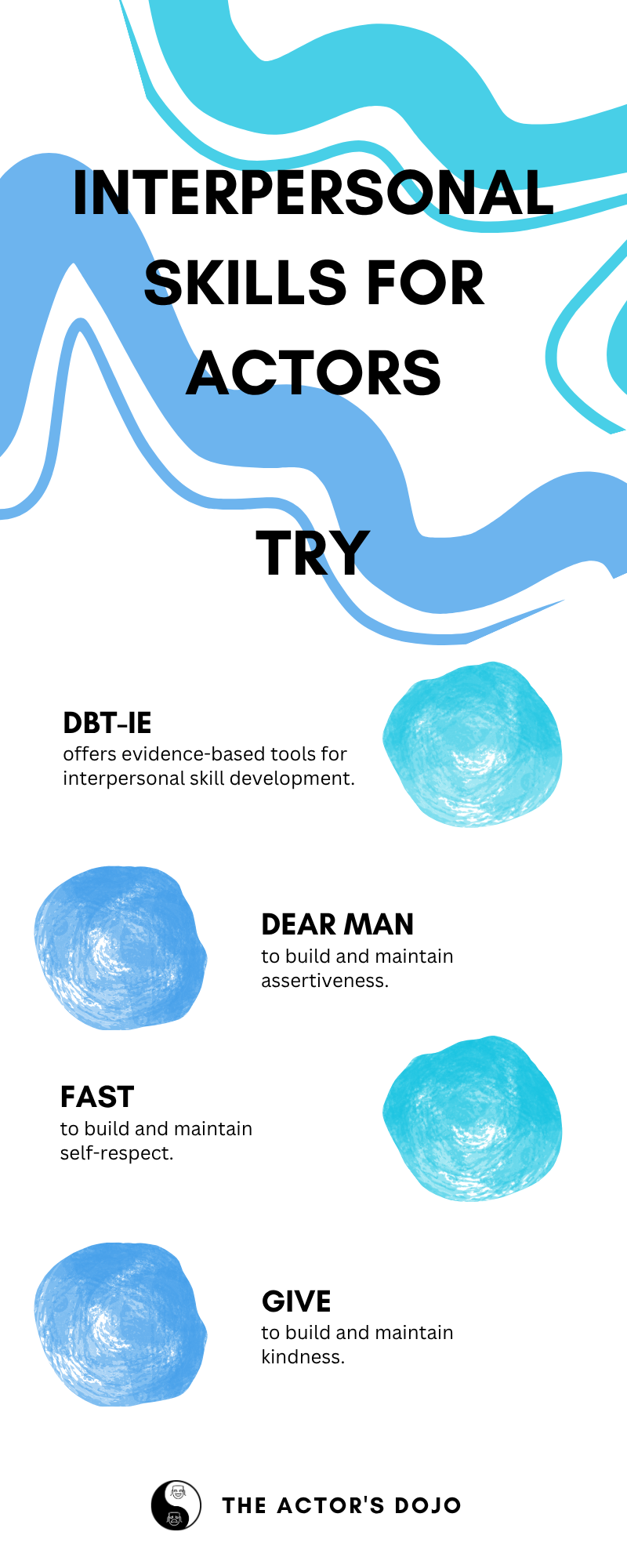
No worries. Here are the three key takeaways:
- Actors aren't formally taught interpersonal skills, which is curious, given the highly interpersonal nature of our work.
- Dialectical Behaviour Therapy's Interpersonal Effectiveness module (DBT-IE) offers one evidence-based framework for developing our interpersonal skills.
- We can use three of DBT-IE's core skills – DEAR MAN, FAST, and GIVE – to build our assertiveness, self-respect, and kindness, respectively.
Love what you're reading? Help us keep it flowing. Donations support the research, writing, and free sharing of evidence-informed tools for actor performance and well-being. Every dollar fuels our mission to make thriving a reality for actors everywhere 🔥
Citations
[1] https://www.jstor.org/stable/45440691, p. 101
[2] [7] https://doi.org/10.14264/2272c6a, p. 88
[3] [5] https://www.human-kinetics.co.uk/9781718201811/social-psychology-in-sport/, p. 341–343
[4] https://doi.org/10.1027/1016-9040/a000294, p. 175
[6] https://doi.org/10.1016/j.psychsport.2022.102247, p. 1
[8] https://dialecticalbehaviortherapy.com/, para. 3
[9] https://dialecticalbehaviortherapy.com/supplementary/life-worth-living/
[10] https://search.informit.org/doi/10.3316/informit.499926749273237, p. 104
[11] https://doi.org/10.1177/2150137816642439, p. 83
[12] https://dialecticalbehaviortherapy.com/, para. 10
[13] https://dialecticalbehaviortherapy.com/interpersonal-effectiveness/dear-man/
[14] https://dialecticalbehaviortherapy.com/interpersonal-effectiveness/fast-skill/
[15] https://dialecticalbehaviortherapy.com/interpersonal-effectiveness/give-skill/
Cite us!
IG: @theactorsdojo
APA 7: Norrish, T. (2026, September 24). Interpersonal effectiveness for actors. The Actor’s Dojo. https://www.dojoactors.com/interpersonal-effectiveness/