When Actors Feel Like Imposters
Us actors have a complicated relationship with confidence. We're constantly told we need it, yet we frequently lack it.
Caught in this cycle of perceived deficiency, many of us come to encounter the imposter phenomenon (aka the imposter "syndrome"). Unfortunately, these encounters often heighten our sense of lacking, making it even harder to reach the confident state we so desperately seek. It can quickly become a self-fulfilling sewer spiral that leaves us feeling alone,[1] depressed, and without hope.[2]
In this article, you'll gain a clear understanding of what the imposter phenomenon is and how, as actors, we can navigate through it.
Backed by science; built for the stage and screen.
👊 Actors:
Get evidence-informed insights and strategies to support your performance and well-being. Join the Dojo e-newsletter tribe and make thriving your reality.
🧭 Drama schools & Production companies:
Bring pioneering, research-backed coaching into your classroom or rehearsal room. Let's talk about supporting your actors to perform at their peak – and stay well in the process.
Understanding the phenomenon
As with many things in the psychological space, an accurate understanding of what we're experiencing can go a long way toward helping us better navigate it.
First, although the imposter phenomenon is popularly referred to as the imposter "syndrome", it isn't truly a syndrome, as it isn't a clinical diagnosis.[3] Simply perceiving this experience more accurately can start to wiggle us toward feeling a little less alone and a little more hopeful.
Common indicators of the imposter phenomenon include:
- A general sense of not being good enough.[4]
- Chronic self-doubt.[5]
- Recurring negative self-talk.[6]
- Ruminating on criticisms, mistakes, and failures.[7]
- Fear of being "found out" or exposed as a "fraud".[8]
- An inability to accept deserved recognition for accomplishments, competence, or skill.[9]
As a result, those experiencing the imposter phenomenon may:
Second, it's helpful to clarify what it is we want to work toward instead. Here, it's helpful to distinguish three related concepts: self-belief, self-efficacy, and self-confidence (our target).
Self-confidence has been defined as "the perceived ability to accomplish a certain level of performance".[12] In contrast, self-belief is broader,[13] and self-efficacy is narrower.[14]
Importantly, self-confidence can be examined as both a trait and as a state.[15] That is, some people are naturally more confident than others, but everyone can feel confident under certain conditions.
Finally, although we're constantly told we should strive to be confident, the confidence-performance relationship is largely misunderstood.
As we continue to underscore, peak performers perform at their peak despite experiencing "negative" (e.g., self-doubting) thoughts and feelings.[16] In short, when it comes to peak performance, confidence is a nice-to-have; not a need-to-have.
That said, peak experience matters too, and feeling confident – whilst not essential – can make performance more enjoyable.
Navigating the phenomenon
With a theoretical understanding in place, let's turn to what psychological science says we can do in practice.
An * before diving in: whilst we, as individuals, can make some moves toward a positive and productive experience, the cultures and contexts we're associated with play a "significant" role, and systemic shifts are often needed to effect "real change".[17]
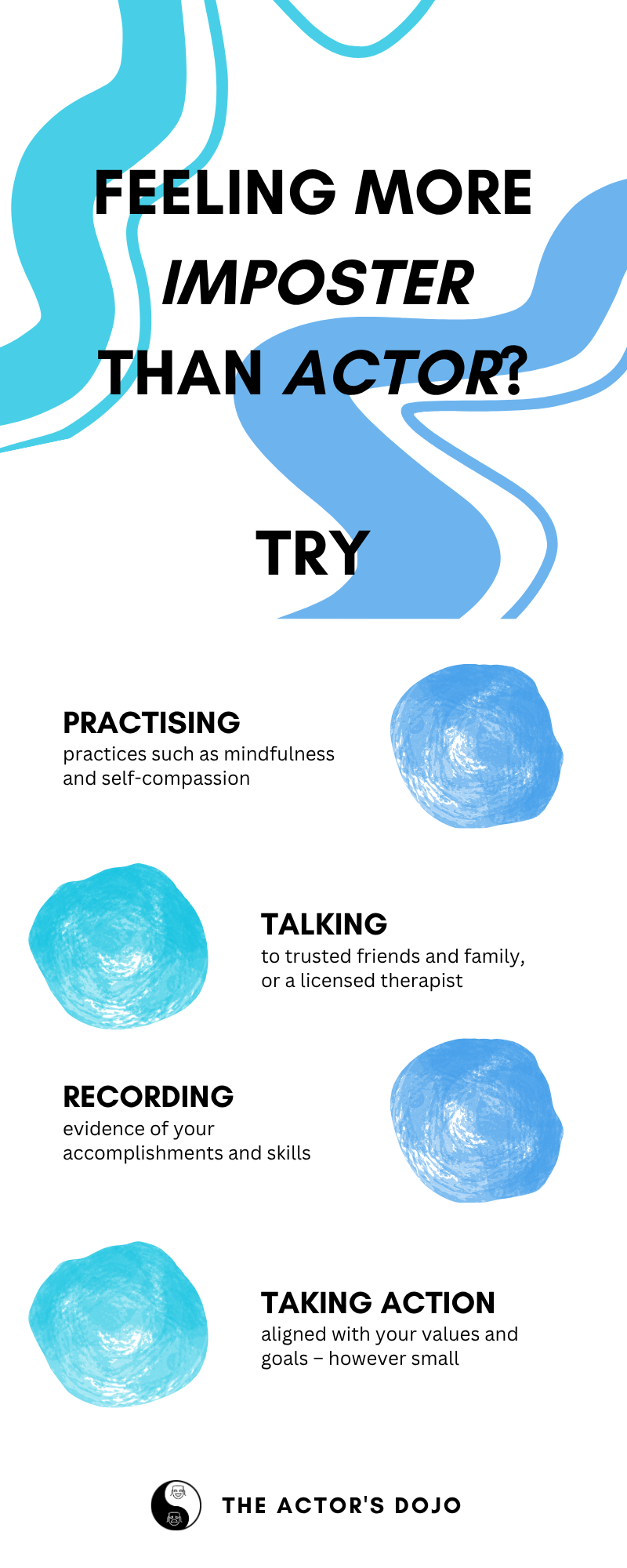
Nevertheless, empowering ourselves is a worthwhile endeavour, and there are several evidence-informed strategies we can turn to:
- Gaining a greater understanding of confidence (job done 👊).[18]
- Mindfulness- and acceptance-based practices.[19]
- Self-compassion practices.[20]
- Sharing thoughts and feelings with a trusted friend, family member, mentor, or licensed therapist.[21]
- Defining a personal definition of "success".[22]
- Celebrating wins – and losses.[23] [24]
- Recording evidence of accomplishment, competence, and / or skill.[25] [26]
- Training and test-driving psychological skills such as self-talk and mental rehearsal.[27]
- And, perhaps most importantly, taking values-aligned action (however small) regardless of how confident we're thinking and feeling.[28]
As mentioned, self-confidence is both a trait and a state, and the imposter syndrome is more a transient phenomenon than a fixed diagnosis. Thus, it's normal and natural for these experiences to ebb and flow.
As a result, it can be wise to think of the strategies above as preventative measures – not just emergency cures. If we vibe with a practice or two, we can do our future selves a favour and return to them regularly.
TL;DR?
No worries. Here are the three key takeaways:
- Framing the imposter "syndrome" more accurately as the imposter "phenomenon" can help us feel a little less alone and a little more hopeful if / when we experience it.
- In the context of peak performance, self-confidence is a nice-to-have, not a need-to-have.
- There are several evidence-informed strategies we can use to prevent seasons of low self-confidence and protect ourselves in the midst of them.
Love what you're reading? Help us keep it flowing. Donations support the research, writing, and free sharing of evidence-informed tools for actor performance and well-being. Every dollar fuels our mission to make thriving a reality for actors everywhere 🔥
Citations
[1] https://www.apa.org/monitor/2021/06/cover-impostor-phenomenon, para. 8
[2] https://www.apa.org/monitor/2021/06/cover-impostor-phenomenon, para. 1
[3] https://www.apa.org/monitor/2021/06/cover-impostor-phenomenon, para. 3
[4] [6] [7] [8] [10] [11] https://www.docs.hss.ed.ac.uk/iad/Researchers/Research_staff/Imposter_Syndrome.pdf, p. 5
[5] [9] https://www.docs.hss.ed.ac.uk/iad/Researchers/Research_staff/Imposter_Syndrome.pdf, p. 4
[12] https://doi.org/10.1249/00003677-198800160-00016, p. 279
[13] https://doi.org/10.1038/s44220-023-00062-8, p. 339
[14] [15] https://doi.org/10.3390/ijerph19116381, p. 2
[16] https://link.amazon/B02rflQlc, p. 16
[17] https://www.apa.org/monitor/2021/06/cover-impostor-phenomenon, para. 12
[18] https://doi.org/10.1080/10413200.2014.996302, p. 10
[19] [20] [21] [23] https://www.apa.org/monitor/2021/06/cover-impostor-phenomenon
[22] https://www.docs.hss.ed.ac.uk/iad/Researchers/Research_staff/Imposter_Syndrome.pdf, p. 8
[24] https://www.docs.hss.ed.ac.uk/iad/Researchers/Research_staff/Imposter_Syndrome.pdf, p. 7
[25] https://www.docs.hss.ed.ac.uk/iad/Researchers/Research_staff/Imposter_Syndrome.pdf, p. 10
[26] https://doi.org/10.1080/10413200.2014.996302, p. 12
[27] https://doi.org/10.1080/10413200.2014.996302, p. 15
[28] https://youtu.be/msK9tTn_sKM?si=xdw8jpshcMbGTdjy, 00:27:10
Cite us!
IG: @theactorsdojo
APA 7: Norrish, T. (2026, July 23). When actors feel like imposters. The Actor’s Dojo. https://www.dojoactors.com/imposter/