How to Grow an Actor
I adored my four years at drama school. Adored. Even today, eight years after graduating, I consider myself incredibly fortunate to have had the experience.
And – eight years after graduating, am I able to put technical words to a subtle-but-problematic dynamic common to Western drama schools and our industry at large: a fondness for a post-traumatic growth approach to training and directing actors. There's an explicit / implicit belief that good training must "break" actors,[1] and that good directing must expose them. In short, that talent needs trauma.
In this article, you'll learn what we can glean from research on both post-traumatic and post-ecstatic stress: an evidence-informed take on how to (more ethically and sustainably) grow an actor.
Backed by science; built for the stage and screen.
👊 Actors:
Get evidence-informed insights and strategies to support your performance and well-being. Join the Dojo e-newsletter tribe and make thriving your reality.
🧭 Drama schools & Production companies:
Bring pioneering, research-backed coaching into your classroom or rehearsal room. Let's talk about supporting your actors to perform at their peak – and stay well in the process.
Moving away from Post-Dramatic Stress
Let's start with some definitions.
Growth, in this context, refers to development in the direction of our fullest potential.[2]
"Much" of the research in the psychological growth space has focused on "the effects of adverse experiences".[3] The concept of "post-traumatic growth" was born after discovering that some people sometimes report positive changes after an adverse experience.[4]
This original research likely underpins the "talent needs trauma" narrative our training and industry environments (in addition to other peak performance environments) seem to intentionally / unintentionally perpetuate. Friend of the Dojo, the wonderful Dr Mark Seton, even coined the term "post-dramatic stress", which encapsulates some of these elements.[5]
An important * here is that post-traumatic growth – while "positive" from a growth perspective – still holds trauma, and is nonetheless associated with mental illness.[6]
More recent research has highlighted yet another important *: it's "not the quality of an event, but the way it is processed, that is critical for the occurrence of post-event growth".[7] [8]
Meaning, "positive events can, in fact, catalyze growth",[9] a phenomenon referred to as "post-ecstatic growth".[10] Indeed, there is "no general evidence for the widespread conviction that negative life events have a stronger effect than positive ones".[11]
In honour of Dr Mark Seton's conceptualisation of post-dramatic stress, we propose its opposite: "post-dramatic growth" – post-ecstatic growth for actors, if you will.
Moving toward Post-Dramatic Growth
What would a post-dramatic growth approach to actor training and directing look like? Unfortunately, no studies have explored this issue as of yet, so there are more open questions than definitive answers.
Nevertheless, we can make some evidence-informed guesstimations based on the research in post-ecstatic growth, as this body of literature has shown that some positive events have a higher chance of resulting in growth than others.[12]
For instance, events in which we experience one or more of the "stronger" positive emotions (think: awe, elevation, and inspiration, for example) seem to offer the biggest bang for their growth buck.[13]
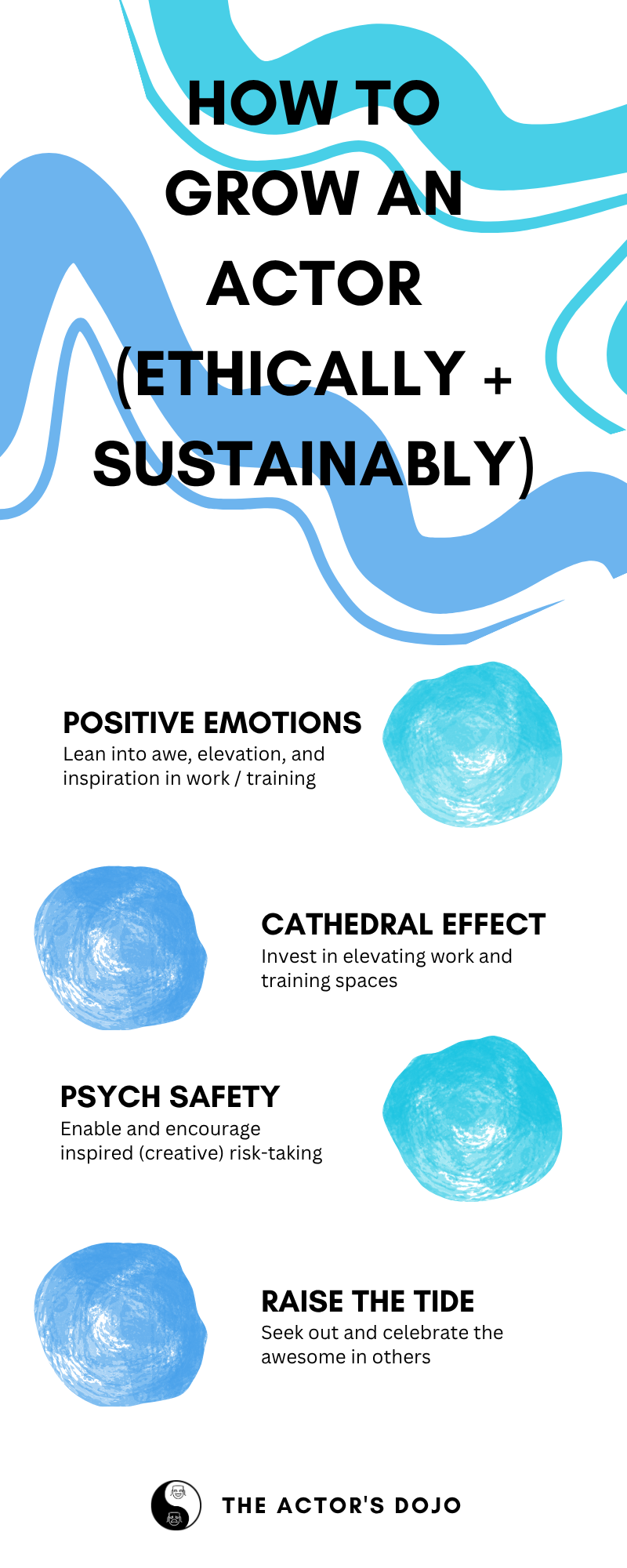
Transposed to the acting world, this may mean investing a little more in the spaces in which we train and work. We've discussed the Cathedral Effect before, but research on post-ecstatic growth may further support the point: elevated workspaces foster elevated work. This needn't be an expensive exercise. I still remember how revitalising it was to have the odd class on the lawn outside our classroom at drama school. It cost nothing to open the door.
Remaining at the contextual level, cultivating a sense of psychological safety in the classroom or rehearsal room may increase the likelihood that the performers within it feel secure enough to act from inspiration – taking those instinctive creative leaps that leave us gob-smacked – than in fear of embarrassment or shame. As I type this, I'm struggling to identify a single instance of growth from a classroom or rehearsal room that intentionally / unintentionally put a cap on inspiration.
At the relational level, this research may encourage us to actively seek out the best in each other instead of low-key hoping to glimpse the worst. Catching a classmate or castmate working at the awesome heights of mastery is more likely to trampoline us to a similar peak than catching a classmate or castmate who's phoning it in – even if their doing so makes us look like a master by default. In short, a rising tide may indeed lift all boats.[14]
TL;DR?
No worries. Here are the three key takeaways:
- As in other peak performance domains, actors are commonly trained and directed with a "talent needs trauma" approach.
- However, there's no evidence that post-traumatic stress facilitates growth more effectively than post-ecstatic stress.
- Based on this research, we can (and should) adopt more ethical and sustainable approaches to "growing" actors. When we know better, we must do better.
Love what you're reading? Help us keep it flowing. Donations support the research, writing, and free sharing of evidence-informed tools for actor performance and well-being. Every dollar fuels our mission to make thriving a reality for actors everywhere 🔥
Citations
[1] https://ro.ecu.edu.au/theses/1804, p. 165
[2] [3] [4] [10] https://doi.org/10.1080/17439760.2013.791715, p. 280
[5] http://hdl.handle.net/2123/2518
[6] [8] https://doi.org/10.1037/bul0000173, p. 330
[7] https://doi.org/10.3389/fpsyg.2015.00813, p. 1
[9] https://doi.org/10.1080/17439760.2013.791715, p. 287
[11] https://doi.org/10.1037/bul0000173, p. 302
[12] [13] https://doi.org/10.1080/17439760.2013.791715, p. 288
[14] https://en.wikipedia.org/wiki/A_rising_tide_lifts_all_boats
Cite us!
IG: @theactorsdojo
APA 7: Norrish, T. (2026, June 25). How to grow an actor. The Actor’s Dojo. https://www.dojoactors.com/grow/