On Being a Person Who Performs
"Sports can make people feel mortal or truly immortal, imbue life with meaning or call it into question; they can solidify identities and self-worth or undermine them; they can make athletes feel all alone or an integral part of something special; they can be vehicles for asserting personal freedom or constrainers of our sense of freedom."[1]
Switch out "sport" for "acting" and "athletes" for "actors", and the above would still hold true, no?
We performers have to strike a fine balance. On the one hand, success demands that we invest a lot of ourselves. On the other hand, wellness requires that we don't invest all of ourselves.[2]
How do we find that sweet spot between "a lot" and "it all"?
In this article, you'll learn why hitting this bullseye is so mission-critical, as well as strategies for going about it.
Backed by science; built for the stage and screen.
👊 Actors:
Get evidence-informed insights and strategies to support your performance and well-being. Join the Dojo e-newsletter tribe and make thriving your reality.
🧭 Drama schools & Production companies:
Bring pioneering, research-backed coaching into your classroom or rehearsal room. Let's talk about supporting your actors to perform at their peak – and stay well in the process.
Person first
As we've mentioned previously, research on actors is limited. However, a common thread in the research that does exist is that actors have "a very strong sense of professional identity", identifying primarily "as an 'actor' no matter how long it was since their last acting job or what work they were doing currently".[3]
As a result of having such a "high level of investment" in our actor identity,[4] when we don't book a job or do a booked job poorly, we often take this as a reflection of us as people, not just performers.[5] In turn, "this can lead to negative self-talk; a lack of self-confidence; the belief that [we] will 'never get a job, never be successful, and should just give up'; and spiraling into a self-fulfilling prophecy that may present further challenges for [our] mental health and well-being as [we] engage in maladaptive coping strategies (i.e., alcohol, drugs, and risk-taking behavior)".[6] Moreover, it's been documented that "during the void between jobs, the actors reported such a loss of identity".[7]
If you've experienced any of the above first-hand (🙋), you know that these aren't the funnest of times.
What you may not know, is that these experiences don't have to be encounters on the actor's path. Equally, safeguarding our sanity doesn't mean we have to sacrifice a part of our identity that we clearly consider important. It needn't be either / or. "Going all in can be a wonderful source of fulfillment so long as you don't completely leave behind other important parts of your identity."[8]

Performer second
As we've also mentioned previously, systemic, sociocultural change is required to make the world a better place for actors (and we're working on it!). In the meantime, however, there are several things we can do to empower ourselves.
To paraphrase a pioneer in dance science, the meta move required is a subtle shift from being "[Your name here] the Actor" to "[Your name here] who acts",[9] and pairing this with building out "multiple rooms in [our] identity house".[10]
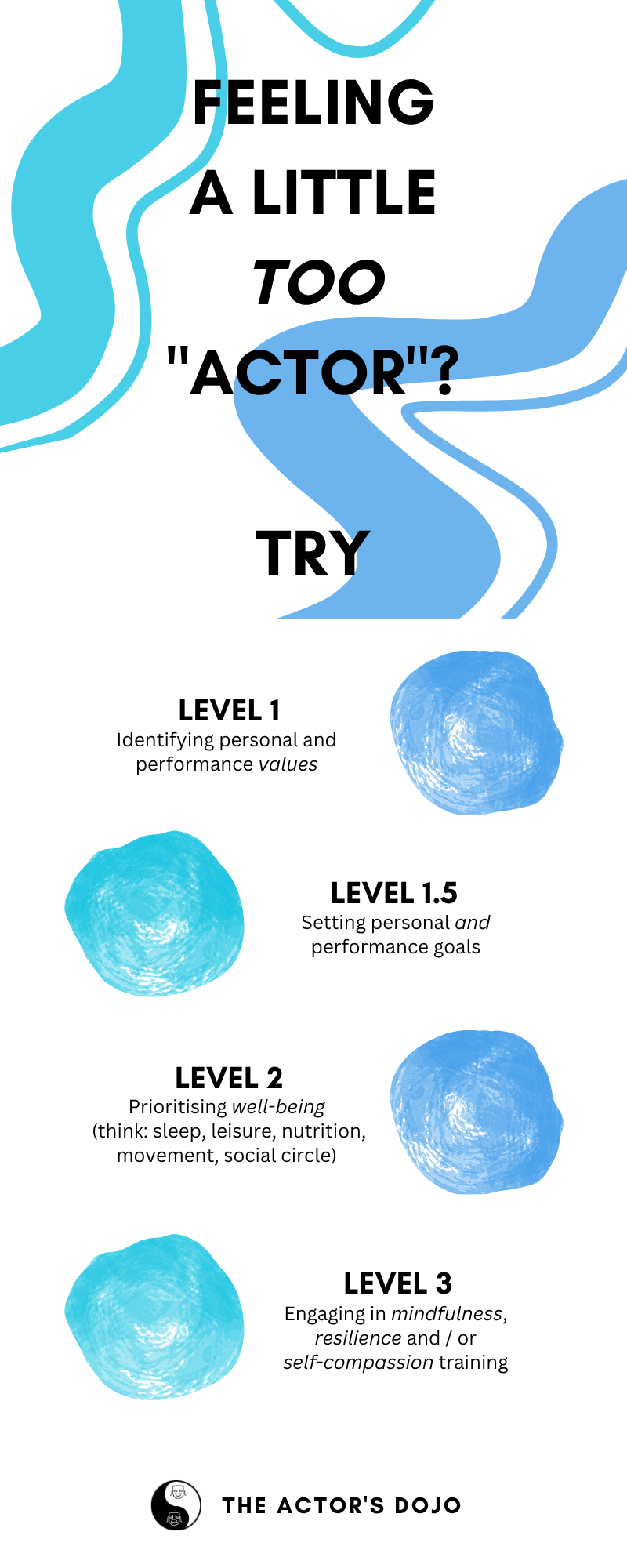
Level 1
- We can start by identifying the values we wish to embody in our personal and performance lives. Values offer a robust foundation. As Maya Shankar has so succinctly shared, "What I strive to do […] is to attach my sense identity and worth not to what I do, but to why I do it".[11]
- From here, we can set goals in all areas of our lives. Doing so not only adds to our identity house, but also increases our self-knowledge,[12] develops our time- and self-management skills,[13] and may reveal pathways to concurrent / alternate education and career opportunities.[14]
- On concurrent / alternate education and career opportunities, let's take it easy on the shame and stigma around pursuing these pathways, yeah? At best, concurrent / alternate education career opportunities can be a source of immense fulfilment. At worst, they provide "some insurance for the future".[15] It also helps to remember that "making progress in other areas of life is in itself fulfilling, and places less reliance on sport [or acting, in our case] for maintaining self-esteem and self-worth both during a career and when it is over".[16]
Level 2
- Next, we can dial in the factors of holistic well-being. Let's make sure our person and performer is sleeping and making time for leisure activities,[17] getting adequate nutrition and movement,[18] staying connected to our inner and wider circles,[19] and considering our financial health.[20]
Level 3
- From here, we can engage in mindfulness, resilience, and / or self-compassion training, all of which show great promise for improving the experience of being a person who performs.[21] [22]
TL;DR?
No worries. Here are the three key takeaways:
- To thrive as performers, we need to hit the sweet spot between investing a lot of ourselves and investing all our ourselves.
- If our "identity house" has only one room, we're more likely to experience mental ill-health on the actor's path.
- We don't need to sacrifice wellness for success – in fact, they are two sides of the same coin. Several evidence-based strategies exist for building additional "rooms" in our identity house.
Love what you're reading? Help us keep it flowing. Donations support the research, writing, and free sharing of evidence-informed tools for actor performance and well-being. Every dollar fuels our mission to make thriving a reality for actors everywhere 🔥
Citations
[2] https://doi.org/10.1016/j.psychsport.2024.102697, p. 2
[3] https://books.google.com.au/books?id=3shEzj0wccgC&printsec=frontcover#v=onepage&q&f=false, p. 139
[4] [5] [6] [9] http://dx.doi.org/10.1037/cpb0000127, p. 102
[7] https://doi.org/10.1111/ap.12221, p. 84
[8] https://amzn.to/4vsF6fS, ch. 7
[10] https://amzn.to/4vsF6fS, ch. 4
[11] https://www.youtube.com/watch?v=hwcm3qDYu8M, 00:07:45
[12] [13] [14] [20] https://doi.org/10.1080/14623943.2012.670625, p. 614
[15] [16] [17] https://doi.org/10.1080/14623943.2012.670625, p. 619
[18] https://doi.org/10.1080/14623943.2012.670625, p. 615
[19] https://doi.org/10.1016/j.psychsport.2024.102697, p. 3
[21] https://doi.org/10.1080/1612197X.2017.1295557, p. 633
[22] https://doi.org/10.1080/00050067.2022.2033952, p. 77
Cite us!
IG: @theactorsdojo
APA 7: Norrish, T. (2026, April 30). On being a person who performs. The Actor’s Dojo. http://www.dojoactors.com/person-performer/